

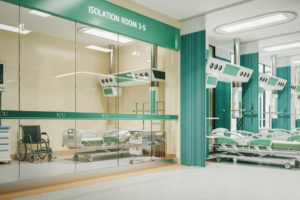
Ask most clinical teams where respiratory isolation happens, and the answer will be a place. The side room at the far end of the ward. The two cubicles in ED that everyone knows are already full.
The association is reasonable, because isolation infrastructure is where the strongest environmental controls sit. Infection risk, though, does not arrive on a rota. Someone can turn up overnight with three weeks of cough and no diagnosis. A patient admitted with a fractured hip spikes a temperature on day four in a six-bedded bay. Two people need airborne precautions on the same afternoon and the unit has one suitable room.
None of that means a hospital’s isolation provision is inadequate. It means capacity and demand are governed by different things. So, the question worth putting to IPC and operational teams is a slightly different one: how quickly can we put precautions in place when the need appears somewhere we had not planned for?
Why fixed isolation capacity can only be part of the picture
Appropriately designed isolation facilities remain essential, and we wouldn’t argue otherwise. HBN 04-01 Supplement 1 sets out what a special ventilated suite must achieve: 10 air changes per hour, roughly minus 5 Pa to the corridor for source isolation, a ventilated lobby, pressure monitoring alarmed to the nurse station and validated against HTM 03-01. Those parameters cannot be improvised. Where a patient has a confirmed airborne infection, that is where they belong.
The difficulty is that the number of such rooms is settled years in advance, and NHS England’s guidance states plainly that provision is a local decision based on demographic trends and population need. Demand moves week to week. Two pressures widen that gap. The first is occupancy: NICE suggested a pragmatic maximum of 90% and NHS planning guidance has used 92%, but average general and acute bed occupancy has sat above both for years and runs near 95% through winter. A ward at 95% has almost no room to move anyone anywhere, let alone into a specific room with specific ventilation.
The second is that respiratory season is never one pathogen. UKHSA’s weekly surveillance routinely tests for influenza A and B, RSV A and B, SARS-CoV-2, hMPV, adenovirus, seasonal coronaviruses and rhinovirus. That matters for cohorting, the usual fallback when single rooms run short. Under the NIPCM, cohorting applies where two or more patients share the same confirmed infection, and patients who are immunosuppressed or unlikely to comply should not be cohorted at all. Four patients with four different viruses cannot be cohorted, and neither can four whose swabs are still pending. It is a familiar problem with suspected tuberculosis, where precautions are needed well before culture results.
A third pressure comes from estates: ventilation plant needs annual verification and rooms come offline, so preparedness has to allow for the infrastructure itself being unavailable. Together these turn respiratory isolation in UK hospitals into an operational problem rather than a design one.

Respiratory infection control needs to follow the patient
The NIPCM requires the potential for transmission to be assessed when a patient enters a care area and reviewed continuously throughout their stay. Its information on optimal patient placement then sets out what each organism needs. Both are instructions about a pathway, not about a room.
Trace a patient with a productive cough and an unclear diagnosis. Ambulance handover, ED majors, a CT slot, a trolley space on the acute medical unit, then a ward bed. That journey can run well beyond twenty-four hours, and the period of greatest onward risk often falls before anyone reaches a designated room. Source control helps, but the manual is explicit that a mask must never compromise clinical care, which rules it out for many who most need precautions, including those on oxygen therapy.
Moving every such patient to specialist infrastructure is the ideal and often impossible. The direction worth considering is the reverse: bringing additional environmental control to wherever the patient currently is, while the pathway plays out. HBN 04-01 Supplement 1 acknowledges as much, noting that its design principles may be adapted to other departments, emergency departments in particular.
Four questions worth asking before winter
Capacity
How many patients requiring respiratory precautions could this site manage at once, today? Not the room count on the estates register. Subtract rooms holding patients who cannot be moved, rooms out for verification, and rooms committed to protective isolation. Compare what is left against the highest number of concurrent respiratory precautions your site recorded last winter. Most trusts have never put those two numbers side by side.
Location
If preferred facilities are unavailable, where do those patients go? An answer amounting to “we escalate to the site team” describes a process, not a capability.
Speed
How long between recognising the need and having precautions in place? The NIPCM asks for single room prioritisation to be reviewed daily, which assumes there is something to prioritise between.
Clinical practicality
Can the measure be applied to a patient who needs cardiac monitoring, oxygen, observations and physical examination? A control clinicians work around gets quietly abandoned by the second shift.
Underneath all four sits the hierarchy of controls, which the NIPCM asks organisations to apply when deciding on transmission-based precautions. Environmental and engineering measures rank above administrative measures and PPE because they work without depending on individual behaviour every time. Most hospitals are well provisioned at the administrative and PPE layers. The environmental layer is where flexibility is thinnest, because it has historically meant building work.
Who owns the decision to isolate at the bedside?
This is the question that stops most trusts, and it is rarely written about. If a patient is managed under a bedside containment device rather than in a side room, and there is later an outbreak investigation, what does the paperwork look like?
The decision itself is not new. The NIPCM already places isolation prioritisation with the clinical team in consultation with IPC, specifically when single rooms are in short supply, and already requires placement decisions and the assessment of infection risk to be documented and handed over. Bedside containment does not create a new decision-maker. It adds an option to a decision already being made, recorded and reviewed daily.
What it needs is a local standard operating procedure agreed with IPC before anything is deployed rather than written afterwards, covering who authorises use and on whose advice, which patients are eligible and which are excluded, how the rationale is recorded, what triggers escalation to a side room, what happens during transfer and imaging, cleaning and hood disposal, and who delivers training.
The exclusions deserve the most thought. Aerosol-generating procedures are the clearest example: clearance of infectious particles after an AGP depends on air changes in the room, with a minimum of 20 minutes expected and 10 air changes an hour in a negative pressure isolation room. A localised device at a bed does not give you that, so AGPs belong in an appropriately ventilated space and the SOP should say so plainly. Confirmed airborne high consequence infectious disease is another. So is protective isolation for immunocompromised patients, which is a different problem requiring positive pressure.
One distinction is worth making to your medical devices group. A regulated medical device used within its stated intended purpose is not the same thing as the improvised screening some sites resorted to in 2020. The first is defensible, the second is not, and conflating them is what makes IPC teams wary of the category.
Evaluating flexible isolation capacity
Isolation decisions rarely stay within IPC. A patient held in ED awaiting a side room occupies a cubicle, may hold an ambulance crew, and shows up in the performance data. Specialist rooms tied up by patients who could be managed elsewhere are unavailable to those who need that ventilation. For procurement teams this shifts the evaluation question, because what is being bought is optional capability: something that may sit unused for months, then matter enormously across three weeks in January. Purchase price is a weak proxy for that.
Start with the evidence. Ask what was tested, by whom, to what standard and under what conditions. Capture efficiency measured in a chamber is not the same thing as performance around a patient who moves, coughs and is repeatedly accessed, and a supplier who can walk you through the test protocol is more use than one who only quotes the headline figure.
Then clinical access, which is where most bedside containment fails in practice. If staff cannot take observations, adjust oxygen or reach a cannula without dismantling the device, it will be dismantled. Ask to see a full set of observations performed on a mannequin with the equipment in place, and check compatibility against the beds, pumps and monitors your trust actually uses.
The practical questions then decide whether it gets used at all. How long from storage cupboard to in use, judged on the timeline a ward would achieve at 2am. Whether deployment needs estates involvement, because anything that does has stopped being flexible. What consumables and filters cost over a year. How much training is required and what it is like for the patient, who has to live inside it.
Bringing isolation capability to the bedside with ShareGuard99®
Those criteria are the ones we designed our own approach around, so it is fair to hold ShareGuard99® against them.
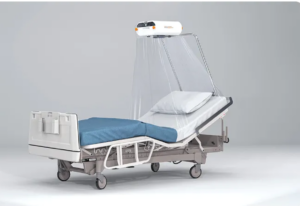
ShareGuard99® adds an environmental layer without adding infrastructure. A frame fixes to an existing hospital bed, an air purifying unit attaches to the frame, and a single-use hood hangs over the patient’s upper body, tucked between mattress and bed. Air from inside the hood passes through a HEPA-13 filter, with capture efficiency verified at over 99% and filtration efficiency of 99.95%, tested at a European research institution, and approximately up to 2.7 Pa of negative pressure inside the hood when used correctly. The differential pressure one-pager sets out how that was measured.
On location, the system fits beds between 510 mm and 900 mm wide, runs from a standard wall socket and needs no ventilation work or structural alteration, so the same unit can serve ED, an assessment unit or a ward bay depending on where the pressure sits that week. On speed, deployment is a frame, a hood and a switch. On clinical practicality, the hood has a zip for patient access and works alongside monitoring equipment, wires, tubes and oxygen therapy. The filter runs for up to 180 days and the hood is single use. At around 49 dBA it is roughly as loud as a domestic fridge, which matters for someone spending days beneath it. Full specifications are in the product brochure.
It is already in routine use. Anne Saarela, Head Nurse at Seinäjoki Central Hospital, reports that the system has helped “improve flexibility when isolation rooms are limited” while supporting practical care delivery for staff and patients.
There are things it does not do, and we would rather say so now than have you find out during evaluation. It does not create a negative pressure room and is not a substitute for a special ventilated isolation suite where one is indicated. It runs from mains power with no battery, so it is a place-based measure: the gap during transfer between departments stays open and has to be managed by other means.
From fixed capacity to flexible preparedness
The Code of Practice under the Health and Social Care Act 2008 asks inpatient providers to make available adequate isolation precautions and facilities. Specialist isolation rooms are not going to be replaced, and nor should they be. But a preparedness plan built around a room count answers only the easiest version of the question. The harder version is what happens on the day demand, location and available facilities do not line up, and how long that gap lasts.
Could your hospital benefit from more flexible respiratory isolation capability?
CLS Surgical supplies ShareGuard99® to healthcare providers across the UK. We can talk you through the test evidence, help you draft a local SOP with your IPC team, and provide staff training and ongoing support. To discuss where bedside patient isolation might complement your existing arrangements, call 0151 733 1900, email customerservice@cls-surgical.com, or get in touch with the team.